Showing posts with label prey. Show all posts

Sunday, November 18, 2012

Opossums - Friend Or Foe?

I never knew much about opossums. I just always saw them as a big ball of fur with a rat tail. I thought they were creatures that had rabies and would bite without being provoked. It turns out that couldn't be further from the truth.

Meet The Opossum!

Opossums are one of the least aggressive animals on the planet. This white creature is about the size of a cat and is the only marsupial in North America. A close relative to the opossum would be the kangaroo.

The gestation period of an opossum is only about 13 days during springtime. A newborn opossum will be the size of an acorn. One of an opossum's babies most distinguished characteristics is that it is born blind but will be able to crawl from the mother's birth canal to her pouch due to the fact that it's legs are long enough to move. The average litter has about 15 joeys. A small percentage of them will live to survive through the sumer.

Their long rat-like tail helps them to climb trees and possibly hang when hiding. However, they do not sleep upside down as many have believed.

Opossum Myths
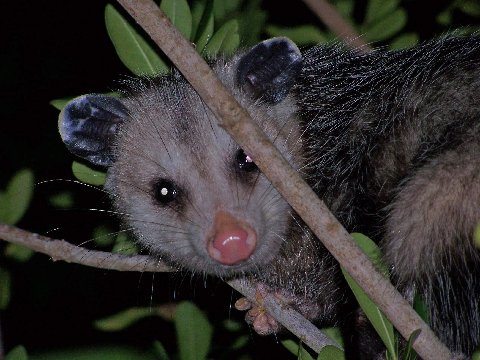
There are many misconceptions about the opossum. They are one of the animals who are least likely to transmit rabies. They have a low body temperature which keeps them from transmitting diseases. Another misconception is that they are aggressive. On the contrary, they will not bite unless provoked. They just want to be left alone.

Possums are known to play dead. However, this is an involuntary action that protects them and not a conscious action. Opossums are friendly animals in general who are omnivores at heart. They will eat insects, roadkill, cat food and dog food. These smart animals are peace loving and completely docile towards dogs. They are even better at protecting gardens from unsightly insects.

All in all, the opossum is one of the oldest living animals in history. If you happen to encounter one on a dark night, don't be fearful of them. They are no more harmful than a squirrel or a cat.

Let's Discuss!

Have you ever had an unusual experience with an opossum?

It's All Related!

Prey Of The Dog: Down Under
Prey Of The Dog: New Zealand
Canines in Conservation

Wednesday, August 22, 2012

Prey Of The Dog: New Zealand


Photo: Evan Goldenberg
New Zealand is two islands in close proximity that have Polynesian origins. It is shared by both the Maori (it's native inhabitants) and the Western European settlers who inhabit it today. It was initially settled in 1642 by Abel Janszoon Tasman from Holland. They had several battles and conflicts with the indigenous people and in 1840, it became an official English colony. Today it is an independent nation in the British commonwealth. Its size is larger than Great Britain and smaller than Australia.

New Zealand is mainly known for its birds and reptiles and has very few species of mammals. As much as dogs have been domesticated, there is always a small part of them that is in touch with their wild side. This can be troubling to certain animals of the Kiwi Island. Most animals who fall into this category are birds and reptiles. Most dogs won't attack. But there are times when one wanders away that the inevitable happens. Below is a list of animals who can be prey.

Birds
  • Blue Duck
    The Blue Duck, also known as the Whio, is an endangered species. It is found on the northern and southern islands. It's roughly 21 inches (53 cm) in size. It has a dove gray color with a hint of blue. Its chest is brown spotted and its feet are dark brown. Females have fewer spots and ducklings have none. They feed on invertebrate snails and larva. They must watch out for feral dogs and cats, as well as, hunting dogs, rats, falcons, hawks and eels.
  • Brown Teal
    The Brown Teal is severely endangered in New Zealand. Today, there are fewer than 1,500 of these birds in existence. They are found along the Great Barrier Island and in Northland. They are extremely territorial — especially during mating season — and will kill their own kind to protect that territory. These nocturnal ducks are known for laying in the grass during the day and swimming at night. A big reason for that it's nocturnal was in response to protecting itself against aerial grabs from large birds such as the Australasian Harrier. Other predators include dogs, cats, stoats and ferrets It is 19 inches large (48 cm) and is known for its distinctive brown coloring.
    Photo: Sabine's Sunbird
  • Great Spotted Kiwi
    The Great Spotted Kiwi is one of the few birds on this island with the inability to fly. Known to inhabit the northwest corner South Island, this bird is in gradual decline. It's a large bird that only lays one egg at a time. Both parents nest the egg during the 2.5 to 3 month incubation period. They are extremely territorial as to protect their egg. Its appearance is known for having a mottled appearance. Predators of this national treasure include the ferrets, stoats, hunting dogs and wild dogs.
  • Kakapo (Owl Parrot)
    The Kakapo is the world's heaviest parrot weighing 8 pounds (3 kg). They have soft moss green and black feathers on their back, combined with yellow-green feathers near their face and underside. It is the only parrot that doesn't fly and is a nocturnal bird. They along with the kereru are the only plant-eating birds. They live in the Fjiordland and Stewart Island. With only 62 of these creatures currently in existence, they have been relocated to predator-free areas. The birds never experience any predators before the Europeans settled. With the settlers came the addition of cats, rats and dogs. Also, the Maori, valued their skins and feathers. In 1952, the rush to conserve the species started and they have been working hard to make sure there was an abundant supply of food in order for them to breed.
    Photo: MNolf
  • Little Spotted Kiwi
    The Little Spotted Kiwi is the smalled of all New Zealand's kiwi birds. It weighs 2.5 to 4 pounds (1.2 - 2 kg) and is 16 inches (40 cm) large. Once they lived throughout New Zealand, now, they are down to 1,200 and can be found on Kapiti Island. They live in the forest beneath deep vegetation or under the roots of trees. Predators of this bird include ferrets, stoats, feral and hunting dogs.
  • New Zealand Dotterel
    The New Zealand Dotterell lives on both the North Island and South Island with the majority of the 1700 birds living in North Island. Around 60 live in South Island which decreased dramatically due to the influx of feral cats. Other predators such as dogs and hedgehogs have put them on the endangered species list. They are about 11 inches (25 cm) in size with a mottled gray top and a light brown underbelly.
    Photo:
    Chris Gin
  • North Island Kiwi
    Like their Kiwi counterparts in other parts of New Zealand, this breed finds itself as prey of dogs, ferrets and stoats. This is also one breed of birds where the female tends to be larger than the male and tends to weigh 3 to 6.5 pounds (1.5 to 3 kg). The average size is 20 inches (50 cm). Their coloring varies from brown and gray to black brown to reddish brown. Some even have white feathers. They will burrow themselves under dense vegetation or hide in hollow logs in the areas of e North Island, Little Barrier Island, Kapiti Island. They were arecently reintroduced into several forests south of Palmerston North.
    Photo: Maungatautari Ecological Island Trust
  • North Island Weka
    The North Island Weka lives on various offshore islands as well as, the Bay Islands and the Bay of Plenty. It's a flightless bird with a large mandible and strong feet. Its coloring is a combination of brown, black and gray. It weighs between 1.5 to 2.5 pounds (700 grams - 1.2 kg). Females tend to weigh less. They are omnivores and will eat anything like, invertebrates, snakes, snails, eggs, birds and rabbits. They are equally territorial as well. Females will kill immature males if they feel threatened. Predators of this bird include stoats, ferrets, cats and dogs.
    Photo: Gail Garber
  • Tuatara
    The tuatara looks like a lizard, but is actually a rare type of reptile called the Sphenodon which translates to "wedged tooth". There are only two types of this species left. The tuatara can live up to 100 years. They are about 20 to 31 inches long (50 to 80 cm). They are known for their olive green coloring and their spiny back. Other tuatara may be colored dark pink or light gray. It is a good swimmer and nocturnal. They eat mostly insects and will occasionally eat smaller animals. It has to watch out for dogs, ferrets, rats, cats, stoats and possums. Due to deforestation in New Zealand, very few tuatara can be found on the mainland anymore. Protected since 1895, this animal resides in predator-free areas of offshore islands around New Zealand.

Let's Discuss!

Which animal of prey is most fascinating to you?

It's All Related!

Prey Of The Dog: Down Under
Why Dogs Love To Chase Moving Objects

Saturday, January 14, 2012

Why Dogs Love To Chase Moving Objects

An Unexpected Attack

Last week, a 62-year-old man was running along a beach. Out of nowhere, two pitbulls chased him and nearly mauled him to death. If a neighbor hadn't intervened, by hitting the dogs with a baseball bat, he would have died. He was admitted to the hospital in a coma.

Because they attacked a human, the dogs shot on site, and the owner was cited with failure to own a proper license as well as failure to restrain each dog. How did this happen? Someone had left the gate open in their backyard.

What makes this story especially tragic was the owner, Jimmy Johnson, was forthcoming when the story broke. He was hoping that these weren't his dogs but his worst nightmare came true.

What Drives Dogs To Chase Objects In Motion

This story is terrifying for all parties involved. It's a situation where all dog owners should be proactive. I couldn't help but wonder what drives them to chase people and other moving objects. All it takes is for a dog to chase a car and get hit. There isn't just one reason but many. Here are some.

They are protecting their territory.
Many dogs feel that their job is to keep watch over their home. A home with a fenced-in yard is practically a requirement for dog owners because it's easy for a dog to take off an running. They will stop at nothing to protect their territory and one of those ways is to chase intruders away.

They are intriguing.
Joggers and bicyclists are interesting to dogs. They are naturally curious and when they see a jogger running by they want to see what's happening.

They view it as prey.
Although dogs are domesticated, many have a natural prey drive. Whether it's a squirrel, rabbit or cat, many are inclined to want to chase them down. Seeing a person or fast moving object can easily trigger the prey drive, especially if the dog is a hunting breed. Dogs don't see this as work, but more as if it's sport.

Final Thoughts
Accidents happen. Not everything can be seen in black and white when it comes to dogs. Even though they are now domesticated, it's always important to remember that they will have a strong animal instinct that comes out from time to time. It's a reminder to owners that being a dog lover comes with an even stronger ability to anticipate these moments.

Let's Discuss!

What are some things that your dog loves to chase that you wish they wouldn't?

It's All Related!

Prey Of The Dog: Down Under
Rabbit Frenzy

I know it's been awhile since I've written a post. I'm in the middle of learning a new technology (Drupal). The process has taken more of my time than usual. Balancing it out with blogging has been quite a challenge but I just wanted to let you know that I will always be writing, just not as frequently. I appreciate your patience and if anyone has any comments or questions, leave them below.

Monday, November 30, 2009

Prey of the Dog: Down Under

Koala BearKangaroos

Even though our dogs are domesticated, many of them have a prey drive that lies within. It's this prey drive that makes them chase, squirrels, rabbits, deer, cats and other animals.

There are two animals that seem to be a target of domesticated dogs in Australia: the kangaroo and koala bear. Both of these wild animals are hugely popular. New of attacks involving these animals have increased quite a bit.

Kangaroos


Young KangarooKangaroos are marsupials. Smaller-sized kangaroos are known as Wallabies. The Red Kangaroo is the largest of the species.

The Kangaroo is the national animal of Australia. Their young which are called joeys are carried in their pouch until they are strong enough to live on their own. They eat plants and grass and survive on very lttle water.

Kangaroos are an animal that can't move backward, only forward. In addition to living in Australia, they also can be found in Tasmania and New Guinea. Their population in Australia has dwindled over 50% since 2001. A large number of that is due to humans hunting kangaroos.Still, they have a large population compared to koala bears.

Koala Bears


Koala in TreeKoala bears are beloved in their homeland of Australia and in other parts of the world. They live solely in Australia and are a protected species. They may be called koala bears but are actually mursupials just like kangaroos. They carry their young in their pouch. Their young are called joeys as well.

They eat only leaves from Eucalyptus trees. It is from these trees that they get their water intake. Due to the fact their diet doesn't give them much energy, these animals can sleep up to 22 hours a day. They have thick, dense fur but store little to no fat in their system. Because of this, they have a very weak defense system if they are attacked. An estimated 4,000 koala bears die from attacks each year.

Why Dogs Attack Them


Domestic dogs have been found too attack these animals for various red kangarooreasons. With the increase of development and, much of their habitat has been destroyed to build roads, homes and businesses. Forest fires have been a further detriment. These animals have no choice but to adjust to their new surroundings and that may mean wandering into a person's backyard.

Some dogs see them as intruders violating their territory. They will chase them out but can easily be kicked to death by a kangaroo whose been put on the defense. Kangaroos are docile animals but if they are provoked they will defend themselves. Another method of survival for a kangaroo is leading the dog to water and then holding it under to drown it with its front paws.

In contrast, koalas can be quite aggressive and will defend themselves by biting or using their sharp claws.

Sometimes, dog owners let their dogs roam off leash in recreational parks. One minute their are walking with their master, the next they are off chasing an animal. The consequences of this can be severe because one of them will die.

What Can Be Done?


Koala AsleepThere are steps that dog owners can take to protect their dogs, have peace of mind, and help kangaroos and koala bears have a better chance at survival:

  • Keep an eye on your dog when you let it out in the yard
    Many times you think the coast is clear and miss that Koala who's been hanging out in your tree.

  • Limit your dogs time outside from dusk to dawn. Since both of them are nocturnal animals, you have a greater risk of seeing them. Instead of leaving them in the yard, take them on a walk instead.

  • Use fencing to keep Koalas out.

  • Know what kind of trees you have, if you have any because they are a target for koalas. This list will tell you what trees are koala magnets. Grass in the backyard is appealing to Kangaroos.

  • If your dog is an outdoor dog, have him sleep in an enclosed area. Many dogs love to be close to their owners so they can protect them. If you don't want them in your house, then have them in your garage or basement

Learn More!
Here are some websites where you can learn more about these magnificent animals:
Animals Australia
Australia Koala Foundation
Australia's National Parks
Kangaroo Protection Coalition
Other Wild Animal Posts
Coyotes
Oh No! My Dog Got Skunked!

Have any of you seen these animals up close? Have you ever witnessed an attack? What are your thoughts on this subject?

BlogCatalog

Dog Blogs - BlogCatalog Blog Directory